

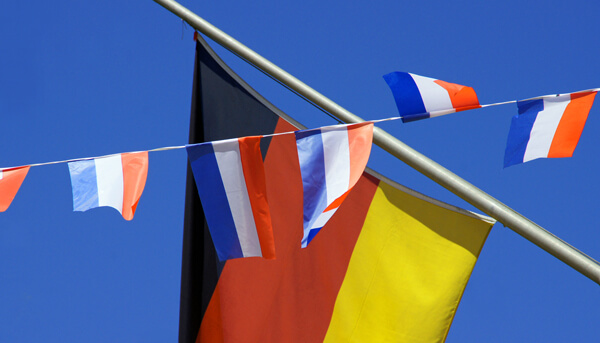

There are currently five Franco-German High Schools: Saarbrücken (since 1961), Freiburg im Breisgau (since 1972), Buc (since 1975), Hamburg (since 2020) and Strasbourg (since 2021).
The establishment of binational schools was announced in the Élysée Treaty of 1963 and took concrete form with the introduction of a Franco-German Abitur on 10 February 1972. The conditions and regulations governing the award of the Franco-German Abitur were laid down in the Schwerin Treaty in 2002. The Aachen Treaty of 22 January 2019 confirms the commitment of both countries to intensify bilateral cooperation in the field of education.
The Franco-German High Schools are state schools in their respective host countries, each with a German and a French section, with some subject lessons in the partner country’s language already taking place from lower secondary level onwards. They have now developed into schools where pupils with a wide variety of first languages are taught in both German and French.
German and French pupils learn and work with German and French teachers, with lessons conducted in the language and according to the teaching style of the respective teacher. From Year 10 (Seconde) onwards, the languages of instruction are divided equally, so that roughly half of the lessons take place in French and the other half in German. The languages are also divided equally in the written and oral A-level examinations.
Promoting mobility is an integral part of every pupil’s educational journey at a Franco-German High School. This is ensured through a variety of exchange and engagement programmes: individual exchanges, partnerships with schools abroad, participation in Erasmus+, eTwinning, etc. This provides them with excellent preparation for a wide variety of linguistic and cultural contexts.
The Franco-German High Schools have now gained extensive experience in the field of multilingual teaching. They are convinced that this experience must be brought to the attention of a wider public, with the aim of sharing and further developing it with France and Germany, as well as with other European countries. In an increasingly globalised world, pupils must acquire not only subject-specific skills but also intercultural competences and become multilingual.
In view of the need to raise awareness of the Franco-German High Schools and to promote understanding of their specific pedagogical and educational qualities, the three school communities have jointly drawn up a ‘Charter’ for the Franco-German High Schools. This is further elaborated upon in the individual mission statements of each school.
The Charter sets out the guiding principles upheld by all Franco-German High Schools across four key areas:
Multilingualism and Interculturalism
Multilingualism and Intercultural Understanding
The school curriculum at the Franco-German High Schools is fundamentally multilingual: German – French – English, with the option of Spanish, Italian or Latin as a fourth foreign language, which is introduced at a later stage.
German-French bilingualism and an excellent command of English as a lingua franca, as well as the acquisition of intercultural skills, are ideal prerequisites for mobility and broadening one’s professional horizons in a globalised world where these skills are urgently needed.
The Franco-German High Schools help to develop educational approaches that enable all pupils – regardless of their first languages – to successfully complete a challenging multilingual and intercultural school career. Beyond the language teaching provided for in the curricula, the first languages and cultures of origin of all pupils are taken into account and valued.
On the one hand, when learning new languages, pupils benefit from the insights they have already gained into the vocabulary and structures of languages they have previously learnt. On the other hand, recognising and valuing different first languages and cultures of origin enables everyone to find their rightful place in a multicultural Europe.
European social commitment
European social commitment
The idea of educating young people to become future European citizens who are proficient in the language and culture of their neighbouring country emerged after the Second World War as part of the process of reconciliation and rapprochement between Germany and France, and was formalised in the Élysée Treaty. In this treaty of friendship, France and Germany declare that, after more than a century of hostility and armed conflict, lasting peace can only be guaranteed if the two neighbouring countries cooperate closely and the countries of Europe form a political union.
Whilst, at the time of the founding of the first Franco-German High School, the focus was still on the reconciliation of the two countries and the strengthening of bilateral relations, today’s Franco-German High Schools go one step further: they open up to Europe and the world.
In our day-to-day work with our pupils, the democratic values of tolerance, freedom of expression and mutual respect are taught and put into practice, so that the young people entrusted to our care may become committed European citizens and help shape European cohesion.
As set out in the report ‘Education for Citizenship in Schools in Europe’, developed under the auspices of the European Commission and published in 2017 in *Democratic Societies*, education for active citizenship encourages pupils to become active, informed and responsible citizens who are able to take on responsibilities within their communities, at national, European and international levels.
With this in mind, education policy in the Franco-German High Schools must enable young people to collaborate effectively and constructively with others. In doing so, they develop a critical mind, act responsibly and democratically within society, and make a comprehensive contribution to defining and achieving the goals of sustainable development that preserves our planet for future generations.
Individualisation of learning processes
Personalisation, differentiation and individualisation of the school career to ensure success at the Franco-German High Schools
The multicultural teaching teams at the Franco-German schools take each pupil into account and do everything in their power to enable them to achieve their full potential throughout their school career in a supportive yet challenging environment.
To achieve this, the teachers’ educational practices aim to recognise the child’s progress and success, thereby helping to foster a love of learning, motivation and self-esteem.
When assessing achievements, the right to make mistakes is recognised, so that pupils can learn from their errors.
The individual educational journey is also underpinned by the differentiation of teaching methods; periods of teacher-led instruction alternate with periods of group work and pupil-centred activities.
Mindfulness & Wellbeing
Mindfulness and respect in our interactions with one another
Well-being of the school community
In a binational and intercultural context, the well-being of all members of the school community is a crucial factor in the success and development of pupils at school, as a place of socialisation and learning.
In the Franco-German High Schools, children and young people, parents, teachers and staff from different nationalities and cultures come together. This multiculturalism is what gives these schools their distinctive character.
We promote peaceful coexistence, a considerate approach by teachers towards pupils, a balance between setting challenges and providing support, and a positive, transparent and confidence-building system of assessment. All these factors contribute to the well-being of our pupils and foster their independence and sense of community. We always keep the well-being and health of everyone involved in school life at the forefront of our minds.
The added value of the German-language schools lies in the fact that pupils learn and work in the partner language with native-speaking teachers, whilst experiencing different education systems and methodological and didactic approaches. Such a learning environment fosters young people’s adaptability and tolerance in an authentic way.
Teachers from both countries of origin also exchange ideas, compare their methods, undertake further training in specific areas and cooperate with one another. They develop sensitivity in dealing with young people who come from diverse backgrounds and international origins. This enriches their professional lives.
Finally, the parents of our pupils are a key pillar of our school community. They, too, come from diverse linguistic and cultural backgrounds. Anyone who chooses a Franco-German High School for their child does so in the knowledge that the philosophy of this type of school must also be supported and lived out by the family. It is a conscious decision in favour of the values we share.
Both school cultures are represented on an equal footing in our schools and enrich one another. This forms the basis and source of our cultural openness and tolerance, our active solidarity and our commitment to the pupils entrusted to our care.