

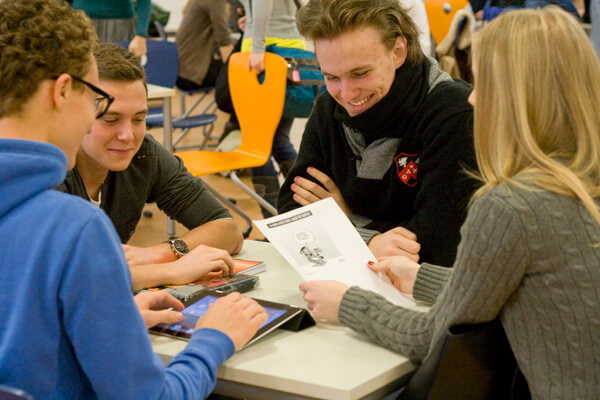

Everyday school life is characterised by elements from both the French and German school systems.
Grades and school reports
Instead of grades from 1 to 6 and a 15-point scale, there are 20 grade levels.
The summer holidays generally last 8 weeks and take place in July and August.
The Franco-German High Schools’ own curricula take into account the content and guidelines of both the Saarland and French educational traditions.
There are no afternoon lessons up to Year 7. From Year 8 onwards, there is one afternoon lesson per week. The remaining time is available for optional classes and clubs.
School rhythm
| Period | Mon | Tue | Wed | Thu | Fri | |
|---|---|---|---|---|---|---|
| 1 | 08:00 – 08:45 | x | x | x | x | x |
| 2 | 08:50 – 09:35 | x | x | x | x | x |
| 15 min break | ||||||
| 3 | 09:50 – 10:35 | x | x | x | x | x |
| 4 | 10:40 – 11:25 | x | x | x | x | x |
| 15 min break | ||||||
| 5 | 11:40 – 12:25 | x | x | x | x | x |
| 6 | 12:30 – 13:15 | x | x | x | x | x |
| 30 min break | ||||||
| 7 | 13:45 – 14:30 | |||||
| 8 | 14:35 – 15:20 | |||||
| 9 | 15:25 – 16:10 |

Lower Secondary Level (Years 5-9)
Orientation phase (Year 5)
At this stage, the curriculum is still aligned with that of other schools in Saarland. The first foreign language is French, which is taught particularly intensively at a rate of eight hours per week. The subject of Arts is taught in French from the outset by a native speaker.
To introduce the children to the new school system as effectively as possible, we run two projects with them: a stay at an experiential learning centre at the start of the school year and a training course lasting several days on working techniques and methodologies during the first term. In addition, a programme to build self-confidence (Lions Quest) is run in Year 5.
Years 6 to 9
All pupils begin learning English as their second foreign language in Year 6. In Year 8, they choose either Latin or Spanish as their third foreign language. There is the option to obtain the Latinum.
A transfer to other schools is possible at any time during lower secondary education, provided the sequence of languages matches.
Through early integration, the language skills of bilingual pupils are supported equally in both languages, whilst the proficiency of monolingual pupils in the partner language is given special encouragement.
Upper secondary level (Years 10-12)
In year 10, pupils choose their specialised and optional subjects for years 11 and 12.
Year 10 → Lessons in whole-year groups with compulsory and optional subjects
Years 11 and 12 → Lessons in courses covering
- the mother tongue
- the partner language
- two specialised subjects
- other compulsory and optional subjects
The classes are fully integrated and lessons are taught by native German or French speakers.
THE PROCESS OF INTEGRATING CLASSES AND SUBJECTS
INTEGRATION takes two forms:
- class integration: pupils from the German section and the French section are no longer distinguished by their section and are placed together in the same classes; they only leave this class group to join a ‘mother-tongue’ group for certain subjects. Classes are integrated from Year 4 onwards
- integration of subjects: integrated subjects may be taught equally by either a German or French teacher in their mother tongue. We aim to strike a balance between the two languages for each pupil.